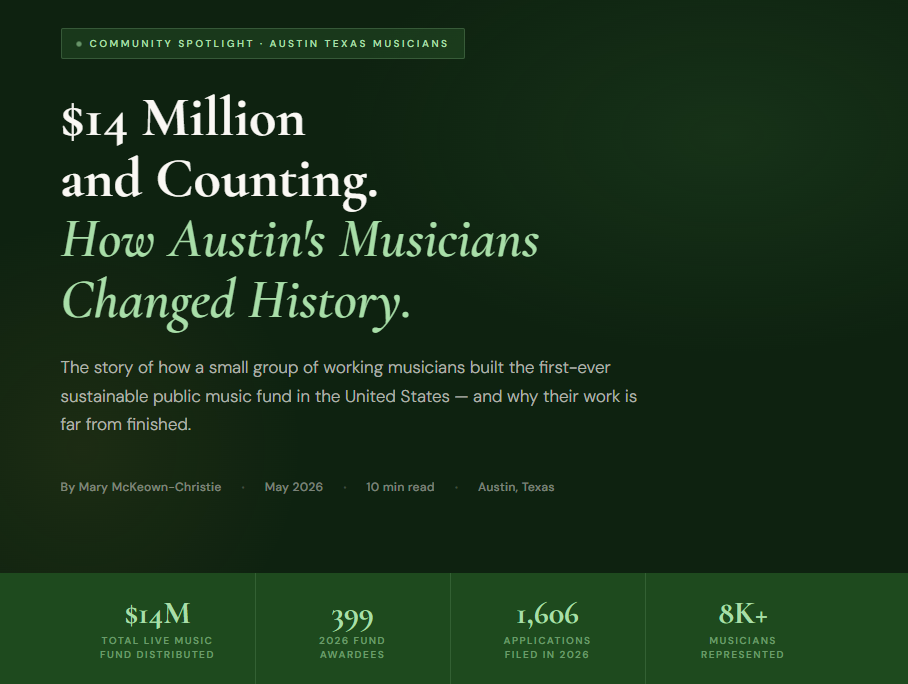
The story of how a small group of working musicians built the first-ever sustainable public music fund in the United States — and why their work is far from finished.
In March 2026, the City of Austin distributed the largest cultural funding cycle in its history — $24 million across arts, music, heritage, and culture. More than $7 million of that went directly to musicians and venues through the Austin Live Music Fund, bringing the all-time total to $14 million. None of it happened by accident.
The Origin Story · 2019
A Fund That Had Never Existed Anywhere in America.
The idea sounds simple enough: take a portion of the Hotel Occupancy Tax revenue that Austin’s booming tourism industry generates — revenue that exists, in large part, because of live music — and return some of it directly to the musicians and venues who make the city worth visiting in the first place. Simple in theory. Structurally unprecedented in practice.
In 2019, ATXM founder Nakia Reynoso and Executive Director Patrick Buchta partnered with the Music Makes Austin coalition — led by Gary Keller — to push City Hall for exactly that: a recurring, publicly funded grant program dedicated entirely to musicians and music venues. No other city in the United States had done it.
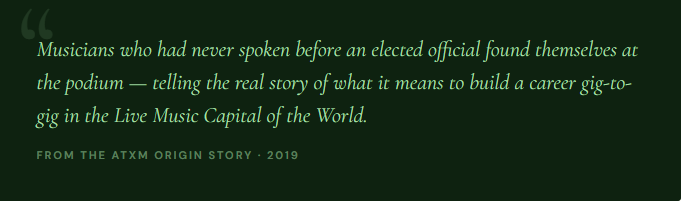
What the coalition had in policy advocates and business leaders, it lacked in the one thing that actually moves elected officials: the organized, authentic voice of working musicians. That’s what ATXM provided. Beginning in spring 2019, ATXM volunteers began showing up—at Tourism Commission hearings, City Council sessions, public comment periods, and every stakeholder table in between. Musicians who had never spoken before an elected official found themselves at the podium, telling the true story of what it means to build a career gig-to-gig in an increasingly unaffordable city.
By May 2019, the coordinated pressure worked: the Austin City Council passed a resolution supporting the creation of a new public music fund. By December, it was official. Austin would create the first-ever Live Music Fund in the United States — a recurring annual allocation of more than $3.5 million, sourced from Hotel Occupancy Tax revenue, dedicated to the people who actually power the Live Music Capital of the World.
Spring 2019
ATXM begins coordinated advocacy at City Hall
Volunteers mobilize for Tourism Commission meetings, Council sessions, and public hearings alongside the Music Makes Austin coalition.
May 2019City Council passes resolution supporting a new music fundA formal resolution acknowledges the need for recurring, dedicated public funding for musicians and venues.
December 2019The Austin Live Music Fund is officially createdThe first recurring, music-specific public fund in U.S. history — $3.5M+ annually from Hotel Occupancy Tax revenue.
2020–2022Pandemic delays — ATXM stays engaged through every setbackThe city approves a separate $5M Venue Preservation Fund. ATXM organizes a City Hall rally — “Ho, ho, ho, let the money go!” — to unblock stalled distributions. ATXM helps secure $6M in federal relief for musicians.
2023First Live Music Fund dollars reach musicians and venuesAfter years of advocacy and pandemic delays, the fund begins distributing. The City forms the new ACME office (Arts, Culture, Music & Entertainment) to improve administration.
March 2026$7.14M distributed — $14M lifetime total reachedThe largest cultural funding cycle in Austin history. 399 awardees. 1,606 applications. The milestone is real — and the need is still nine times greater than available funding.
March 2026 · A Historic Milestone
$7.14M Awarded. Austin’s Biggest Investment in Music — Ever.
The March 2026 grant cycle, administered by the newly established Austin Arts, Culture, Music and Entertainment (AACME) office under Director Angela Means, was a landmark moment for Austin’s creative community. Across all four major programs — the Live Music Fund, Elevate, Creative Space Assistance, and Heritage Preservation — 731 recipients shared $24 million in cultural funding. Of that total, the Live Music Fund distributed $7.14 million to 399 awardees: musicians, venues, promoters, and music industry professionals across Central Texas.
The scale of unmet demand tells the more urgent story.
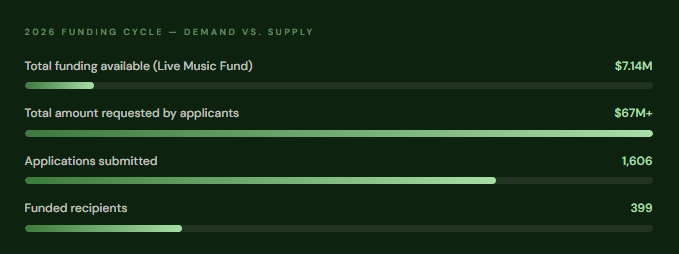
For every dollar available, more than nine dollars in documented need went unmet. This is not a bureaucratic footnote — it’s the clearest possible argument for why advocacy must continue, why the fund must grow, and why ATXM’s work is as urgent in 2026 as it was in 2019.
The 2026 cycle was also the first shaped by “The Creative Reset” — a community-driven rethink of how Austin invests in its creative workforce, drawing input from more than 1,500 participants who contributed over 11,000 comments. ATXM was an active voice throughout: pushing for transparent scoring, equitable access criteria, and a process that demystifies rather than discourages participation.
Economic Development · Crisis Relief & Fair Pay
“Ho, Ho, Ho — Let the Money Go.”
The Live Music Fund is ATXM’s signature win — but it’s far from the complete picture. Across paid performances, pandemic crisis relief, and fair-pay standards, ATXM has built a track record of economic impact that reaches working musicians where it counts most: in their wallets.
When COVID-19 shut down live music overnight, the City approved a $5 million Austin Live Music Venue Preservation Fund to keep venues alive. But the money stalled. An external administrator — the Better Business Bureau — was selected despite having no grantmaking experience, and the bureaucracy froze. Venues that had survived for decades were months away from permanently closing their doors.
ATXM organized a high-visibility rally at City Hall. Venue workers and musicians showed up in force, bullhorns in hand. Kevin Russell of Shinyribs arrived in a purple Santa suit and led the crowd chanting: “Ho, ho, ho — let the money go!” Every major press outlet in Austin showed up. Within days, the funds began moving. Cornerstone Austin stages — Far Out Lounge, Antone’s, Stubb’s, Saxon Pub, White Horse, Sagebrush, and more — survived because the community refused to let them disappear quietly.
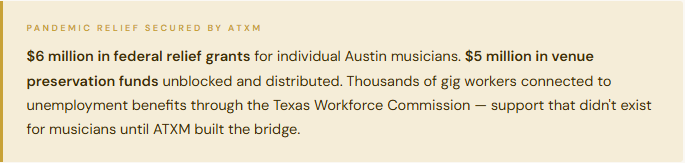
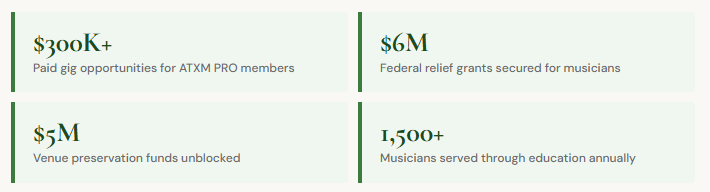
Beyond crisis relief, ATXM worked directly with Austin City Council to establish a standardized $200 minimum pay rate for all city-funded performances — a policy baseline that continues to protect artists at every city-sponsored show. And through partnerships with The Trail Conservancy, Easy Tiger, Armadillo World Headquarters, and Workforce Solutions, ATXM has generated $300,000+ in paid performance opportunities for ATXM PRO members, all at or above that $200 standard.
The education side compounds the economic impact: more than 1,500 musicians served annually through free or low-cost programming, with 92% reporting increased confidence in the business, legal, and financial dimensions of their careers. Hundreds have launched new income streams — sync licensing, royalty collection, freelance creative services, and studio work — because they finally had access to the knowledge that used to be reserved for artists with expensive managers and lawyers.
Accountability · Working with ACME
When $25M in Arts Funding Raised Hard Questions, ATXM Stayed at the Table
Getting money distributed is one thing. Making sure it reaches the right people — fairly, transparently, and efficiently — is a harder, slower job. That’s where ATXM’s ongoing relationship with the City’s ACME office has become equally critical.
The 2024 Live Music Fund cycle exposed real friction in the system. Investigative reporting in the Austin Current revealed that many musicians and venues were left confused about how scores were calculated, why certain applicants were funded while comparable ones were not, and how stated equity priorities were actually weighted in final decisions. ATXM took the community’s frustration seriously — not by amplifying grievance, but by staying at the table and advocating for concrete structural changes: clearer scoring rationale, pre-application workshops to help musicians submit stronger materials, and public-facing criteria that demystify the entire process.
Then, in early 2026, scrutiny turned to the Long Center for the Performing Arts, which had administered Austin’s broader arts grants program for years. Questions about oversight structure, administrative costs, and accountability prompted a city audit. By March, city officials confirmed that changes were coming — including the possibility of selecting a new administrator or bringing grant distribution in-house entirely. An April review flagged continued gaps in oversight of Austin’s $25 million arts contract, keeping sustained pressure on the ACME office to demonstrate accountability to the community it serves.
ATXM’s position throughout has been consistent: the grant program is vital, and transparency is equally vital. The path forward isn’t division between institutions and artists — it’s clarity. Education, public-facing evaluation criteria, and honest dialogue between the city and the music community are the tools that transform a confusing process into one that actually works for working artists.